

Choosing an export market is not a contest to find the biggest economy. For an Indian MSME, the best first destination is one where a specific buyer needs your product, you can meet the market’s requirements, and the full cost of serving that buyer leaves room for a viable business. Start with a shortlist, then verify the assumptions before investing in a launch.

Define the market you are actually choosing
An export market is more than a country name. It is a product offered to a defined buyer, for a particular use, through a route you can serve. “Europe” or “the Gulf” is too broad to evaluate; a country, customer segment and product specification give you something testable.
Before comparing destinations, write down the product’s likely buyer, the problem it solves, its key specifications and the price range you need to achieve. Decide whether you are targeting importers, distributors, retailers, manufacturers or direct consumers. The right buyer type affects packaging, order size, sales effort and delivery expectations.
This focus also helps you avoid a common mistake: treating general interest in a product category as proof that your own offer will sell. Your actual decision is whether a particular customer group can and will buy your product under realistic terms.
Screen demand with trade data, then test it with buyers
Trade data can reveal where products like yours are already imported, but it cannot prove that buyers will choose your offer. Use it to identify promising destinations and questions for follow-up, not as a substitute for conversations with potential customers.
First, identify the correct product classification with an appropriate trade adviser. Then compare import patterns across candidate markets, checking the value and direction of trade and the countries already supplying that product. The International Trade Centre’s Trade Map and Market Analysis Tools provide trade and market-access resources that can support this early screening.
Next, investigate whether demand is accessible to a new supplier. Ask prospective buyers what they currently purchase, what they would need to switch, which specifications matter and how they evaluate suppliers. A credible discussion about a sample, quotation or trial order is more useful than a vague compliment or an unverified market-size figure.
Keep evidence and assumptions separate. For each country, record what published trade information suggests, what a buyer has confirmed and what remains unknown. This prevents a large headline market from outranking a smaller market where you have stronger buyer evidence.
Compare competition and your reason to win
A market with established suppliers can still be attractive if your offer solves a need they do not serve well. Compare your product with the alternatives a buyer can already source, including local suppliers and imports from other countries.
Look for specific differences buyers value: a specification, dependable small-batch supply, customisation, service, packaging or a total delivered price. Then ask whether your business can deliver that difference consistently. “Good quality” or “competitive pricing” is not enough unless you can explain what the buyer gets and support the claim.
Notice how concentrated the supply appears to be and whether buyers rely on a few major suppliers. Treat these as prompts for buyer research rather than automatic reasons to enter or avoid a country. Ask what would make a buyer trial a new supplier and what evidence they expect before placing an order.
Check tariffs, rules and market access early
Market access can change the economics of an export, so check product-specific requirements before committing to a destination. A country that looks attractive on demand may require certifications, labels, testing, permits or documentation that add cost and time.
Confirm the product classification before reviewing tariff information; a mistaken classification can make comparisons misleading. Use current official resources to investigate duties and non-tariff measures, and verify requirements with the destination market’s regulator or a qualified trade professional. The International Trade Centre’s Market Access Map is one resource for exploring tariffs and trade measures.
For the India-side process, check current Directorate General of Foreign Trade (DGFT) guidance and the Indian Customs ICEGATE portal. Requirements vary by product and transaction. Confirm what applies to your business with the relevant authorities and advisers rather than assuming one general checklist covers every shipment.
Calculate the cost of serving each market
A promising destination must work after the full cost of delivering the product, not just the production cost. Build a comparable estimate for each shortlisted market using the same product, order quantity and delivery assumptions.
Include production, samples, quality checks, packaging and any product adaptation.
Estimate inland transport, handling, freight, insurance, agent or distributor charges and financing costs.
Add relevant testing, certification, translation, labelling, duties or other market-specific expenses, verifying which party is responsible for each.
Consider payment timing, currency movement, possible damage or rework and the cost of servicing the buyer after delivery.
Ask a logistics provider for route and shipment estimates, then test whether the margin survives reasonable changes in freight, currency or order volume. State the delivery term and named place clearly in any comparison; responsibilities differ depending on the agreed arrangement.
Do not select a market based on a single best-case quotation. A useful estimate shows what must be true for the order to remain commercially sensible, and what would make you revise or decline it.
Assess how easily you can reach and serve buyers
Access includes more than distance. Consider how you will find qualified buyers, communicate with them, provide samples and support the product after sale. A nearby destination may be operationally complicated, while a farther market may have established channels that fit your product.
Map the likely route to market. Identify possible importers, distributors, trade platforms, industry associations or direct-sales channels, then estimate the time and cost needed to qualify partners. Check language and documentation needs, expected response times, service obligations and whether your team can manage the relationship.
For a first export, favour a path you can learn from. A focused pilot with a verified buyer may teach you more than a broad launch across several countries, especially when your team is still refining pricing, packaging or delivery processes.
Use a simple scorecard to narrow your shortlist
A scorecard makes the trade-offs visible, but it does not replace judgment. Compare a small number of candidate markets against the same criteria and mark weak evidence separately from strong evidence.
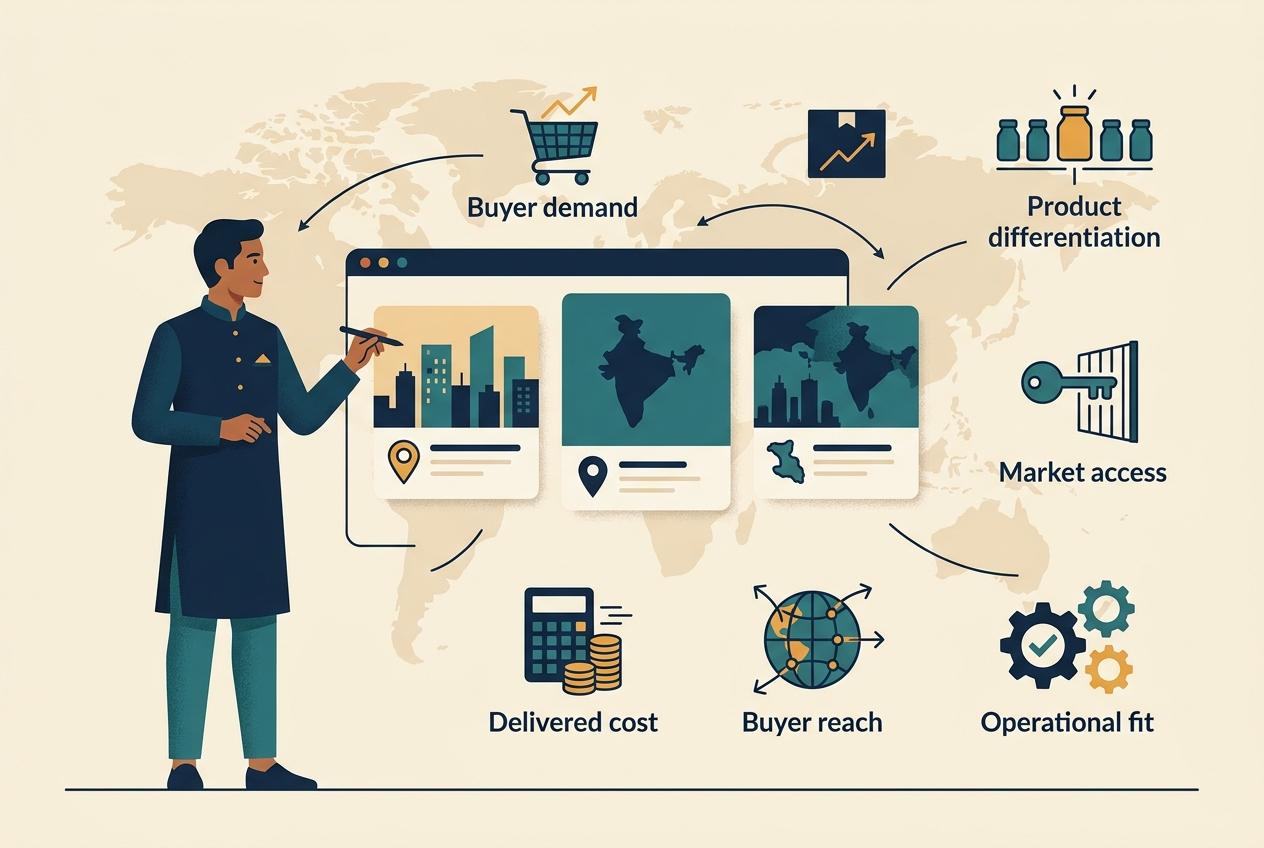
For each destination, rate these factors from low to high using your own evidence: buyer demand, strength of your competitive difference, market-access complexity, landed-cost viability, buyer reachability and operational fit. Add a confidence note beside every rating. A promising score based mostly on unverified assumptions is a research priority, not a green light.
You can weight the factors that matter most to your business. For example, a highly regulated product may need a stricter compliance screen, while a fragile or bulky product may make delivery economics more important. These weights are management choices, not universal benchmarks; write down why you chose them so the decision can be reviewed later.
Before selecting a winner, check whether a critical issue should act as a stop sign. An unresolved product approval, an unworkable delivered cost or no credible buyer route may outweigh an otherwise attractive score. Keep the shortlist open until the most important unknowns have an owner and a next step.
Validate one market before scaling
The strongest first market is the one that passes desk research and buyer validation. Speak with potential buyers, request feedback on specifications and packaging, and test a sample or limited pilot where practical. Confirm the purchase process, order expectations, delivery terms and payment conditions in writing.
Set a decision point before the test begins. Decide what evidence would justify a larger commitment, what would require a product or price change, and what would make you pause. This turns early activity into a learning process rather than an open-ended search for reassurance.
India goes Global’s first-export readiness checklist can help you review buyer credibility, delivery capacity, full costs and compliance before accepting an overseas order. Use the market-selection work to decide where to investigate; use a readiness review to decide whether your business is prepared to proceed.
Frequently asked questions
Start with a manageable shortlist rather than researching every possible destination. Compare candidates using the same product, buyer profile and criteria, then focus deeper research on the markets with the strongest evidence and a reachable buyer path.
Not automatically. Large demand can come with intense competition, higher access costs or difficult buyer entry. Choose a market where demand, your product’s advantage, the economics and your ability to serve buyers fit together.
International Trade Centre tools such as Trade Map and Market Access Map can help investigate trade flows and access conditions. Use them alongside destination-country official guidance and direct conversations with prospective buyers; no single tool confirms that your specific offer will succeed.
Check product classification, relevant tariffs and market requirements, the full cost of delivery, buyer credibility and your ability to meet specifications and timelines. Confirm India-side requirements through current DGFT and ICEGATE guidance and seek qualified advice where needed.
 Made with Levo