

Sitemap

Asia / Market profile

South Korea

A research starting point for understanding South Korea from an Indian business perspective.

Last updated: 4 October 2026

India
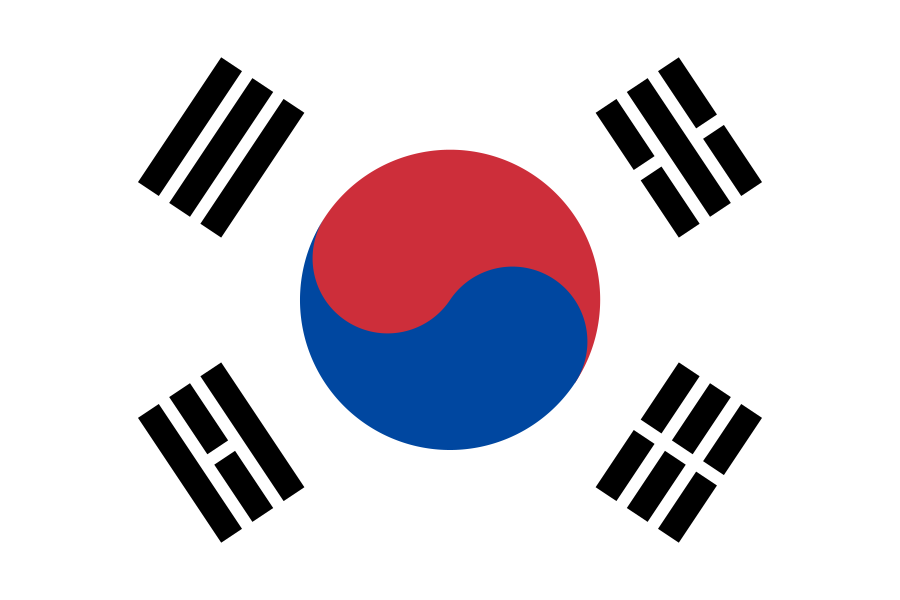
South Korea flagSouth Korea

India-focused research

South Korea country briefing artwork

Country overview

Capital
Seoul
Region
Asia
Currency
South Korean won (KRW)
Time zone
UTC+9; no daylight saving

Source: Time.is

View source
South Korea flag

Market snapshot

Key indicators for the selected market. Country indicators are dated; trade figures use the latest available year.

Population

51.75M

2024

World Bank

View source
GDP

US$1875.39B

2024

World Bank

View source
GDP growth

2.0%

2024

World Bank

View source
Import market size

US$631.77B

2024

WTO Tariff & Trade Data, WTO IDB

View source
Indicator notes & verification

World Bank indicators and WTO IDB merchandise imports refer to 2024. Imports exclude services. Country-specific regulatory requirements remain research prompts unless supported by an attached source.

Last verified: 4 October 2026

Data years: Population: 2024; GDP: 2024; GDP growth: 2024; Import market size: 2024

India-South Korea trade relationship

Historical exports and leading recorded products, not a forecast of demand.

US$6.63B

-2.6% YoY

India exports to South Korea (2024)

Source: CEPII BACI HS17 via India Trade Routes

See full trade series
Trade notes
2023: US$6.80B2024: US$6.63B
Direction only; not a scaled chart.

Recorded route summary

India recorded exports to South Korea in every BACI year from 2017 to 2024. In 2024, India's exports to South Korea were $6.63B, down 2.6% year over year. The 3 largest HS6 products by value were Petroleum oils and oils from bituminous minerals, not crude: preparations n.e.c. containing by weight 70% or more of petroleum oils or oils from bituminous minerals: these being the basic constituents of the preparations: waste oils (HS 271000, $1.34B, 20.3% of the total); Aluminium: unwrought, (not alloyed) (HS 760110, $553.3M, 8.3% of the total); Turbo-jets: of a thrust exceeding 25kN (HS 841112, $552.9M, 8.3% of the total).

Top Indian exports to South Korea (2024)

  1. 1
    Petroleum oils and oils from bituminous minerals, not crude: preparations n.e.c. containing by weight 70% or more of petroleum oils or oils from bituminous minerals: these being the basic constituents of the preparations: waste oils. Expand full product description.

    HS6 271000

    US$1.34B
  2. 2
    Aluminium: unwrought, (not alloyed). Expand full product description.

    HS6 760110

    US$553.30M
  3. 3
    Turbo-jets: of a thrust exceeding 25kN. Expand full product description.

    HS6 841112

    US$552.94M

Why research this market?

Four research lenses to understand the market, not a recommendation to enter it.

Demand

South Korea recorded US$631.77B of merchandise imports in 2024. Investigate product-specific buyers before drawing demand conclusions.

View details Demand

Source: WTO Tariff & Trade Data, WTO IDB (2024)

View source

Check the linked evidence and its date before acting.

Capability

Review technical fit, localisation, delivery capacity and support.

View details Capability

This research guidance has no linked supporting evidence yet.

Access

Research India-Korea CEPA schedules and rules of origin for the actual product.

View details Access

Source: India Ministry of Commerce

View source

Check the linked evidence and its date before acting.

Expansion

Assess staffing, operating responsibilities, costs and decision points before committing.

View details Expansion

This research guidance has no linked supporting evidence yet.

Explore sectors

Choose a research focus. No sector has been established as an opportunity in this country.

Market entry

Possible routes to evaluate, not recommendations for this country.

Direct sales

Evaluate buyer access, contracting, delivery and support.

  1. 01Indian business

  2. 02Entry route

  3. 03Buyer or partner

  4. 04Local operations

  5. 05Expansion

Questions before entering

Check these against your product, HS code and business model.

Regulatory & compliance

Verify current requirements with the relevant authority before acting. This is not legal or tax advice.

01

Business registration

Verify incorporation, investment and activity permissions with the relevant authority.

View details Business registration

What to verify

Verify incorporation, investment and activity permissions with the relevant authority.

02

Import & export

Verify classification, documentation, restrictions and importer responsibilities.

View details Import & export

What to verify

Verify classification, documentation, restrictions and importer responsibilities.

03

Tax

Verify entity and transaction tax obligations with qualified advisers.

View details Tax

What to verify

Verify entity and transaction tax obligations with qualified advisers.

04

Data & privacy

Verify processing, privacy and sector requirements for the data involved.

View details Data & privacy

What to verify

Verify processing, privacy and sector requirements for the data involved.

05

Product requirements

Verify standards, conformity, labelling and approvals.

View details Product requirements

What to verify

Verify standards, conformity, labelling and approvals.

06

Sector-specific regulation

Identify the regulator and verify activity permissions.

View details Sector-specific regulation

What to verify

Identify the regulator and verify activity permissions.

India connection

Explore sourced bilateral information relevant to Indian businesses.

No institutional endorsement or partnership is implied.

IndiaSouth Korea flagSouth Korea
01

India-to-country trade

Explore recorded exports and products in the trade section above.

View trade data
02

India-Korea CEPA

India's Ministry of Commerce records signature on 7 August 2009 and entry into force on 1 January 2010. Verify applicable schedules and origin documentation.

Source: India Ministry of Commerce

View details India-Korea CEPA

India's Ministry of Commerce records signature on 7 August 2009 and entry into force on 1 January 2010. Verify applicable schedules and origin documentation.

Use the source and its scope to guide further research; no relationship or tariff entitlement is implied.

Source: India Ministry of Commerce

Last verified: 4 October 2026

View source
03

Relevant Indian institutions

The Indian Embassy in Seoul provides official bilateral resources. No institutional endorsement is implied.

Source: Indian Embassy Seoul

View details Relevant Indian institutions

The Indian Embassy in Seoul provides official bilateral resources. No institutional endorsement is implied.

Use the source and its scope to guide further research; no relationship or tariff entitlement is implied.

Source: Indian Embassy Seoul

Last verified: 4 October 2026

View source
04

Potential ecosystem connections

Identify potential partners through further research. No relationship is implied.

View details Potential ecosystem connections

Identify potential partners through further research. No relationship is implied.

Use the source and its scope to guide further research; no relationship or tariff entitlement is implied.

05

Relevant bilateral resources

Consult official embassy resources and verify their scope for the intended activity.

Source: Indian Embassy Seoul

View details Relevant bilateral resources

Consult official embassy resources and verify their scope for the intended activity.

Use the source and its scope to guide further research; no relationship or tariff entitlement is implied.

Source: Indian Embassy Seoul

Last verified: 4 October 2026

View source

What should a business research next?

Identify the product and HS code, test demand, verify CEPA eligibility, import requirements, standards and taxes before comparing routes.

  1. 01

    Understand the market

  2. 02

    Identify relevant sectors

  3. 03

    Assess your readiness

  4. 04

    Evaluate entry routes

  5. 05

    Identify partners

  6. 06

    Build an expansion plan

Discover → Prepare → Connect → Expand

Turn research into a plan

Start with your business context before drawing conclusions about a market.

Made with Levo